← All devices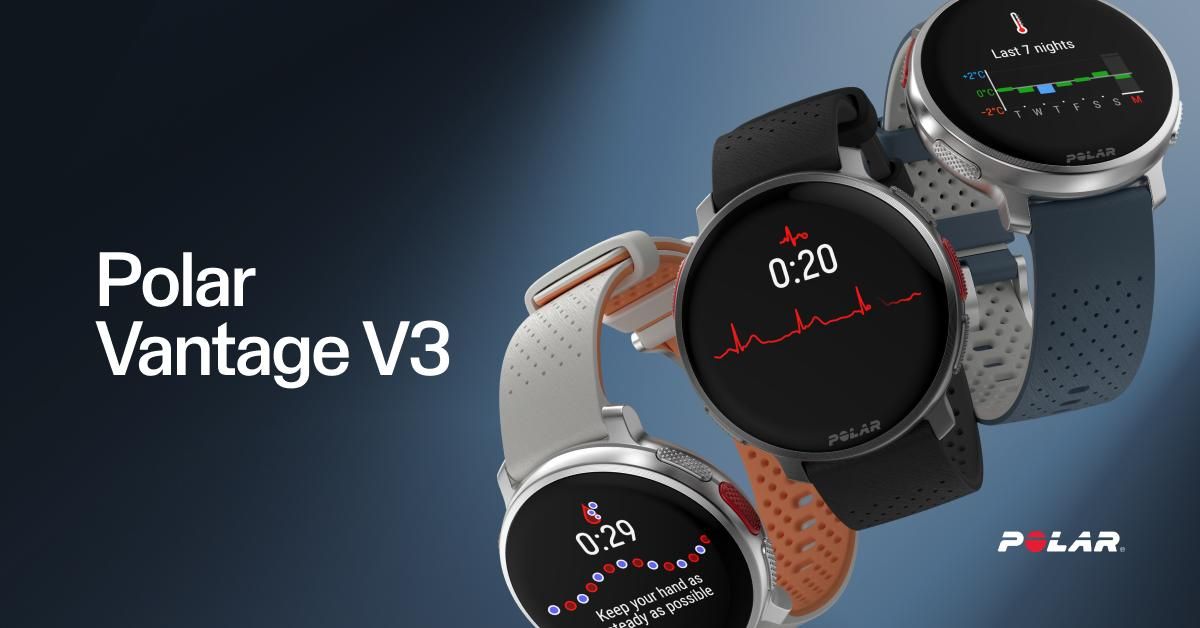
Consumer flagship · Watch · by Polar
Polar Vantage V3
A training-and-recovery multisport watch with one of the most open data ecosystems here — but wrist ECG and SpO2 are wellness-only, with no clearances.
October 2023Polar Vantage V3
Maturing2 yr 9 mo old
Polar Elixir biosensing platform — shared with the 2024 Vantage M3.
API access: Yes — openRaw data access: Yes — openOpen source: Official SDK
Clinical value
35/100
Wellness-only wrist ECG + SpO2
Empowerment
76/100
Open API, full export, no subscription
Everyday value
74/100
AMOLED, maps, ~10-day battery
A premium multisport training watch with one of the most open data ecosystems in wearables — free API, full export, no subscription — but its biosensing (wrist ECG, SpO2, skin temperature) is wellness-only, with no FDA clearance and no AFib detection.
What it measures
Continuous optical HR, HRV (Nightly Recharge, Orthostatic Test), 30-second wrist ECG, SpO2, nightly skin temperature, sleep stages (Sleep Plus Stages), training load and recovery, dual-frequency GPS, and 150+ sport profiles.
Regulatory status
No FDA clearance — a general wellness / sports device. The wrist ECG is explicitly not a medical device and does not detect AFib; SpO2 and skin temperature are wellness features. SpO2 was validated against arterial measurement using ISO medical-device protocols (RMSE < 3.5%), but the device is not cleared for diagnosis.
Validation & accuracy
Polar reports its SpO2 sensor meets ISO medical-device test protocols (RMSE < 3.5% vs arterial blood). Its optical HR and training-load science are well regarded for sports use; there is no diagnostic validation because no clinical claims are made.
Data control & export
Raw data: open — Polar Flow offers a full 'download all your data' export plus per-session export (TCX / GPX / CSV). API: open — the free Polar Open AccessLink developer API exposes Flow data, with broad third-party sync (Apple Health, Google Fit, Strava, TrainingPeaks, komoot).
Wearability & battery
Aluminium sport watch with a 1.39-inch AMOLED touchscreen and offline maps; ~10 days in watch mode (≈43 h GPS training). Comfortable for training and sleep, but larger and more sport-focused than a mainstream smartwatch.
Cost & access
One-time purchase (~$/€599). No subscription — Polar Flow and core features are free. Optional bundled trials (Strava, komoot, TrainingPeaks, Clue).
Who it serves
Endurance and multisport athletes who want deep training/recovery analytics and full ownership of their data; not aimed at clinical monitoring.
Who is left out or burdened
Premium price; bulky, sport-focused design; biosensing is wellness-only so it offers nothing a clinician would act on; lacks full smartwatch-ecosystem features (apps, payments, cellular).
✓ Strengths
- One of the most open data ecosystems here: free Open AccessLink API plus full data export
- No subscription — Polar Flow and core features are free with a one-time purchase
- Cross-platform with broad third-party sync (Apple Health, Google Fit, Strava, TrainingPeaks)
- Deep, well-regarded training-load and recovery science; ~10-day battery and offline maps
✕ Weaknesses
- Wrist ECG is wellness-only — no FDA clearance and no AFib detection
- SpO2 and skin temperature are wellness features, not clinically actionable
- Premium price (~$599) and a bulky, sport-focused design
- Not a full smartwatch ecosystem (limited apps, no payments/cellular)
35
Why this clinical score. Wrist ECG and SpO2 are wellness-only — no FDA clearance and no AFib detection — so nothing here is a clinically actionable, diagnosis- or dosing-grade output. ISO-validated SpO2 lifts it slightly above pure-wellness rings, but it sits near the bottom of the clinical axis.
76
Why this empowerment score. Among the most open ecosystems in the directory: a free, documented Open AccessLink developer API, full account-data export, per-session TCX/GPX/CSV, broad third-party sync, cross-platform support, and no subscription at all — very little lock-in.
74
Why this everyday score. A capable everyday sport watch — bright AMOLED touchscreen, offline maps, music controls, notifications, 150+ sport profiles, and ~10-day smartwatch battery — though it's training-focused rather than a full app-ecosystem smartwatch.
Reviews & coverage
Reviewers praise the reliable optical HR, deep training-load/recovery tools and Polar's sports-science pedigree. Criticisms are a less flashy interface and a smaller app ecosystem than Garmin.
Summary is a draft synthesis of public coverage, not an endorsement. Links open a search of each outlet.
Reddit communities
Independent user communities where this device (or its category) is discussed.
Get it · manuals & support
Draft profile · public-source review, June 2026 · scores describe direction and degree, not buying advice. News, links, and prices change — verify with the manufacturer. Image is representative.